
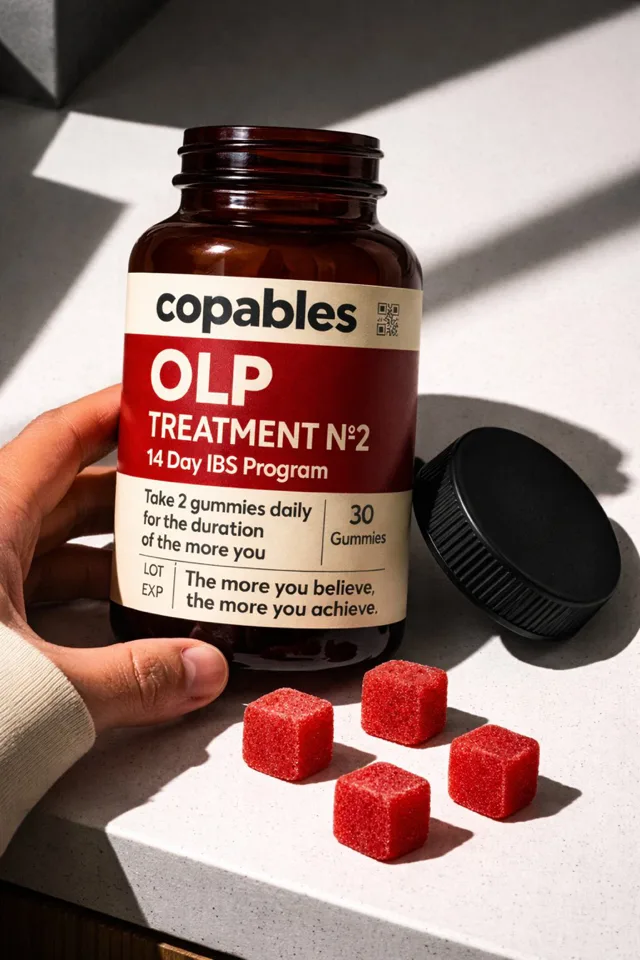
Yes, honest placebos can work. Here's how.
The evidence behind one of the most fascinating findings in modern medicine.
A 2010 Harvard study changed what we knew about placebos.
In 2010, a team at Harvard told eighty patients with IBS that the pills they were about to take were sugar pills — no medicine in them, nothing to absorb, nothing to do anything. They were asked to take them anyway, twice a day, for three weeks. After three weeks, the patients on the sugar pills were doing roughly twice as well as the patients who took nothing. They knew the pills were inert. The pills helped anyway.
Kaptchuk et al., 2010, PLoS ONE. — View Study →



Three distinct mechanisms grounded in neuroscience.
Three overlapping responses, each with decades of research behind it.
Conditioned Expectation
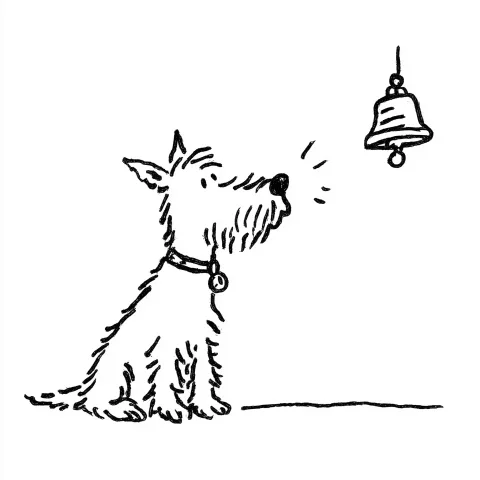
Your body has spent a lifetime learning that engaging with pills, rituals, and care often precedes relief — and reading about people like you who have gotten better strengthens that learned response. This creates a new prediction in your brain: this might help me, because it's helped others.
Symptom Loop Reset
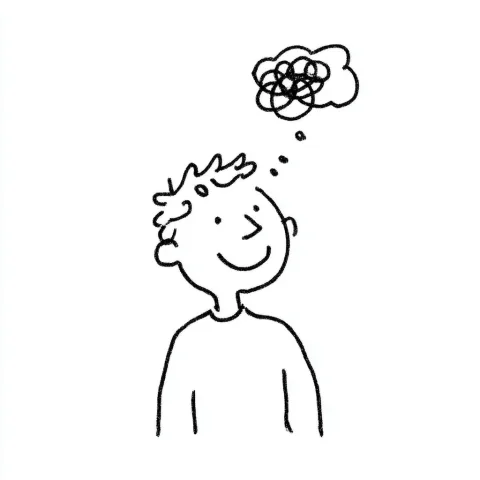
Functional symptoms create noisy feedback loops that amplify themselves — your body senses something off, your brain interprets it as danger, the alarm escalates. An honest placebo protocol can interrupt these loops, giving your nervous system a chance to recalibrate.
The Reward of Action
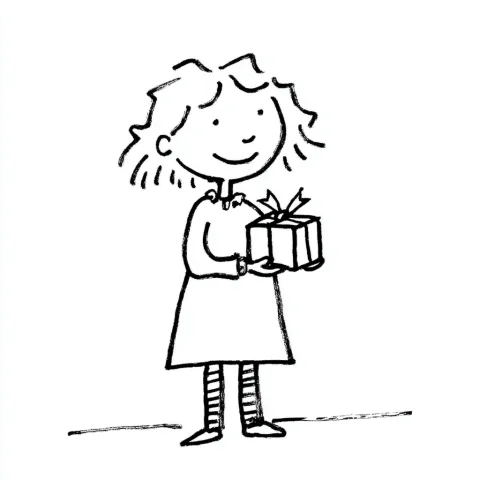
Choosing to take action activates reward pathways in the brain. Neuroscience shows that the act of doing something feels measurably better than doing nothing — like when you decide to take a different route due to traffic. You feel better when you have ownership over your life.
Honest placebos can match deceptive ones.
The double-blind trial — where neither patient nor doctor knows which pill is which — is the standard for proving a drug works. So in 2021, the Harvard group ran the obvious experiment. 262 IBS patients, six weeks, three groups: open-label placebo, double-blind placebo (disguised as either a sugar pill or peppermint oil, the way a real drug trial would run it), or no treatment at all. The two placebo groups improved by the same amount. Statistically, you couldn't tell them apart. Hiding the pill didn't make it work better.
Lembo et al., 2021, PAIN. — View Study →How a placebo is framed changes how it works.
In 2014, a Harvard team gave 66 migraine sufferers a series of pills to take across multiple migraine attacks. Sometimes the pill was Maxalt, an effective migraine drug. Sometimes it was sugar. And sometimes the labels were swapped — real Maxalt in an envelope marked "placebo," sugar pills in an envelope marked "Maxalt." The same chemical produced different amounts of relief depending on what the envelope said. Maxalt called placebo worked about as well as placebo called Maxalt. And the most striking result of all: a sugar pill honestly labelled "placebo" still produced more than half the pain relief of the real drug. The label is part of the medicine.
Kam-Hansen et al., 2014, Science Translational Medicine. — View Study →Research-backed results across five conditions.
Handwriting changes how you think.
A Copables protocol is designed around physical interaction — in addition to your placebo, you'll complete a daily card by hand, grounded in cognitive behavioural therapy, the most evidence-backed treatment in mental health.
The physical act of writing forces you to process your thoughts more deeply, allowing new patterns to take hold.
Who responds best to OLPs.
The OLP responder literature is young, but three predictors have replicated across multiple trials.
People who understand the science.
You don't have to believe the protocol will work for you specifically. You just have to find the science behind it credible enough to engage with. People who score the rationale as plausible respond more strongly than those who don't.
People who want to take back control.
OLP works best for people in an active stance toward their condition rather than a passive one. Across multiple trials, people who feel they're taking action on their symptoms benefit more than people in a watchful-waiting frame.
People who actually show up.
The strongest predictor of OLP response is behavioural adherence — people who do the protocol get the protocol's effects. Belief in whether it will work doesn't predict outcome. Willingness to show up, day after day, does.
Peer-reviewed
research.
Every Copables protocol is designed from the research of the world's leading scientific institutions — the studies that shaped our understanding of Open Label Placebos (OLPs).
Each study below answers a question the one before it raises.
Placebos can work even when you know.
Eighty IBS patients were told plainly that their pills were inert sugar pills, and asked to take them anyway — twice a day, for three weeks. After three weeks, they were doing roughly twice as well as the patients who took nothing.
Read paper →Brain scans show OLPs create legitimately different brain activity.
In an fMRI study, an honest-placebo group reported less distress to upsetting images — and three brain regions lit up differently, the same regions that quiet down under real anti-anxiety medication. A parallel result showed a 22% reduction in negative emotions versus control.
Read paper →How the placebo is framed changes how the placebo works.
Across multiple migraine attacks, the same chemical produced different amounts of relief depending on what the envelope said. A sugar pill honestly labelled "placebo" still produced more than half the pain relief of the real drug. The label is part of the medicine.
Read paper →An honest placebo can match a deceptive one.
262 IBS patients, six weeks, three groups. The open-label placebo group and the double-blind placebo group improved by the same amount — statistically, you couldn't tell them apart. Hiding the pill didn't make it work better.
Read paper →Open-label placebo for premenstrual symptoms.
A 2025 randomized controlled trial reported a 79% reduction in PMS symptoms.
Read paper →Open-label placebo and performance anxiety.
A 46% reduction in anxiety-induced test failure. Driving-test failure dropped from 53% to 29%.
Read paper →Open-label placebo for cancer-related fatigue.
29% improvement in fatigue severity in cancer survivors, and a 39% improvement in fatigue-disrupted quality of life.
Read paper →Cognitive behavioural therapy and lasting remission.
Across guided CBT trials for depression and anxiety, 52% achieved lasting remission at 12-month follow-up — versus 39% for treatment-as-usual.
Read paper →A sensible place to start.
Open-label placebos don't work for everyone — but they're a low-stakes intervention that might. If you're serious about wanting to feel better, we'd recommend trying this lightweight approach before moving on to more drastic measures.
Open-label placebos aren't the right tool for everyone. This protocol isn't intended for anyone in acute psychiatric crisis, anyone whose symptoms could mask a condition where delayed treatment has structural consequences (inflammatory bowel disease, for example, rather than IBS), or anyone for whom the premise itself feels unacceptable. If any of those describe you, please speak to a clinician before starting.